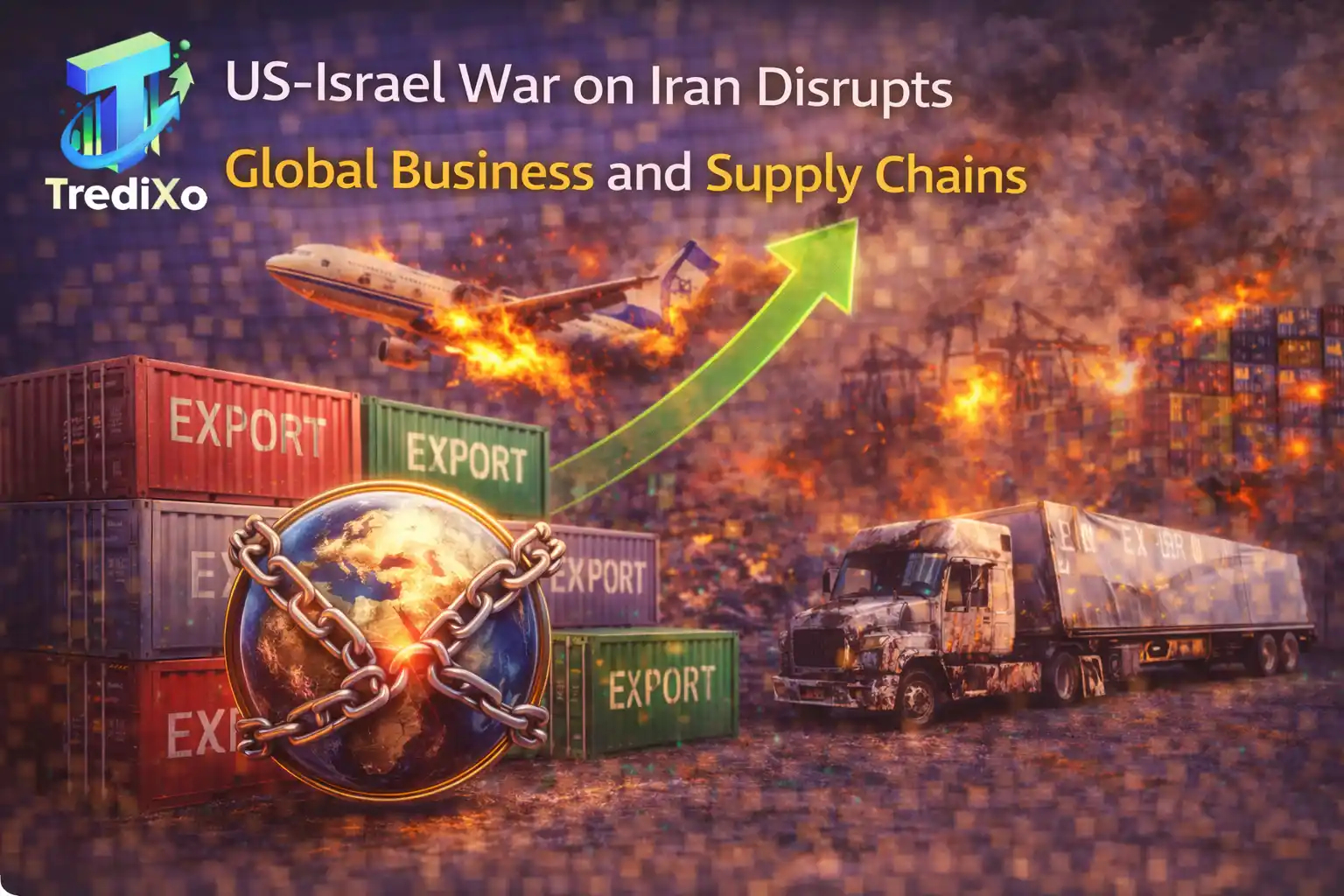
US-Israel War on Iran Disrupts Global Business and Supply Chains.

The ongoing conflict involving the United States, Israel, and Iran has created major disruptions across global markets, trade routes, and supply chains. Businesses around the world are facing rising costs, delayed shipments, and uncertainty as geopolitical tensions in the Middle East intensify. The region plays a crucial role in global energy supply and international trade, making any instability immediately visible in financial markets and business operations.
One of the most significant impacts of the conflict has been the sharp rise in global energy prices. Oil prices surged above 100 dollars per barrel as fears grew about potential disruptions in the Strait of Hormuz, a vital shipping route for global energy supplies. Higher oil prices increase transportation and manufacturing costs, which directly affect industries such as logistics, automotive production, and aviation. As fuel costs rise, companies often pass these expenses on to consumers, contributing to higher global inflation.
Supply chains have also been affected by shipping disruptions and airspace restrictions in the Gulf region. Cargo flights have been rerouted or cancelled, and shipping companies are forced to take longer routes to avoid conflict zones. These delays are affecting the movement of goods ranging from electronics and machinery to clothing and consumer products. Major retail and manufacturing sectors that rely on global supply networks are particularly vulnerable to these disruption global markets, trade .
The technology sector is also monitoring the situation closely. Several critical materials used in semiconductor production are sourced from the Middle East, including helium and other industrial gases. If the conflict disrupts these supply chains, global chip production could face delays, which may affect industries such as consumer electronics, artificial intelligence, and data centers.
In addition to manufacturing challenges, airlines and travel companies are experiencing major operational disruptions. Airspace closures in parts of the Middle East have forced airlines to cancel flights and reroute aircraft, increasing travel time and fuel consumption. Business travel and tourism in key regional hubs have also slowed significantly as companies reassess safety and logistics concerns.
Financial markets have responded quickly to the geopolitical uncertainty. Stock markets, commodity prices, and currency markets have shown increased volatility as investors evaluate the potential economic impact of the conflict. In times of global instability, investors often shift capital toward safer assets such as gold, commodities, and defensive investments.
Conclusion
The US-Israel war on Iran highlights how regional conflicts can quickly influence global business operations and supply chains. Rising energy prices, shipping disruptions, and uncertainty in critical raw material supplies are already affecting industries worldwide. While markets may stabilize if tensions ease, prolonged conflict could continue to disrupt trade and increase economic pressure on businesses and consumers across the globe. All the content credit goes to Tredixo.
FAQs
What is causing global business disruption in the Iran conflict?
The conflict is increasing energy prices, disrupting trade routes, and affecting the supply of key industrial materials.
Why is the Strait of Hormuz important for global trade?
It is one of the world’s most important shipping routes for oil and other commodities, making it critical for global energy supply.
How are supply chains affected by the war?
Shipping delays, airspace closures, and increased logistics costs are slowing the movement of goods across global markets.
Which industries are most affected by the conflict?
Energy, transportation, manufacturing, technology, and retail industries are among the sectors most impacted by the disruption.