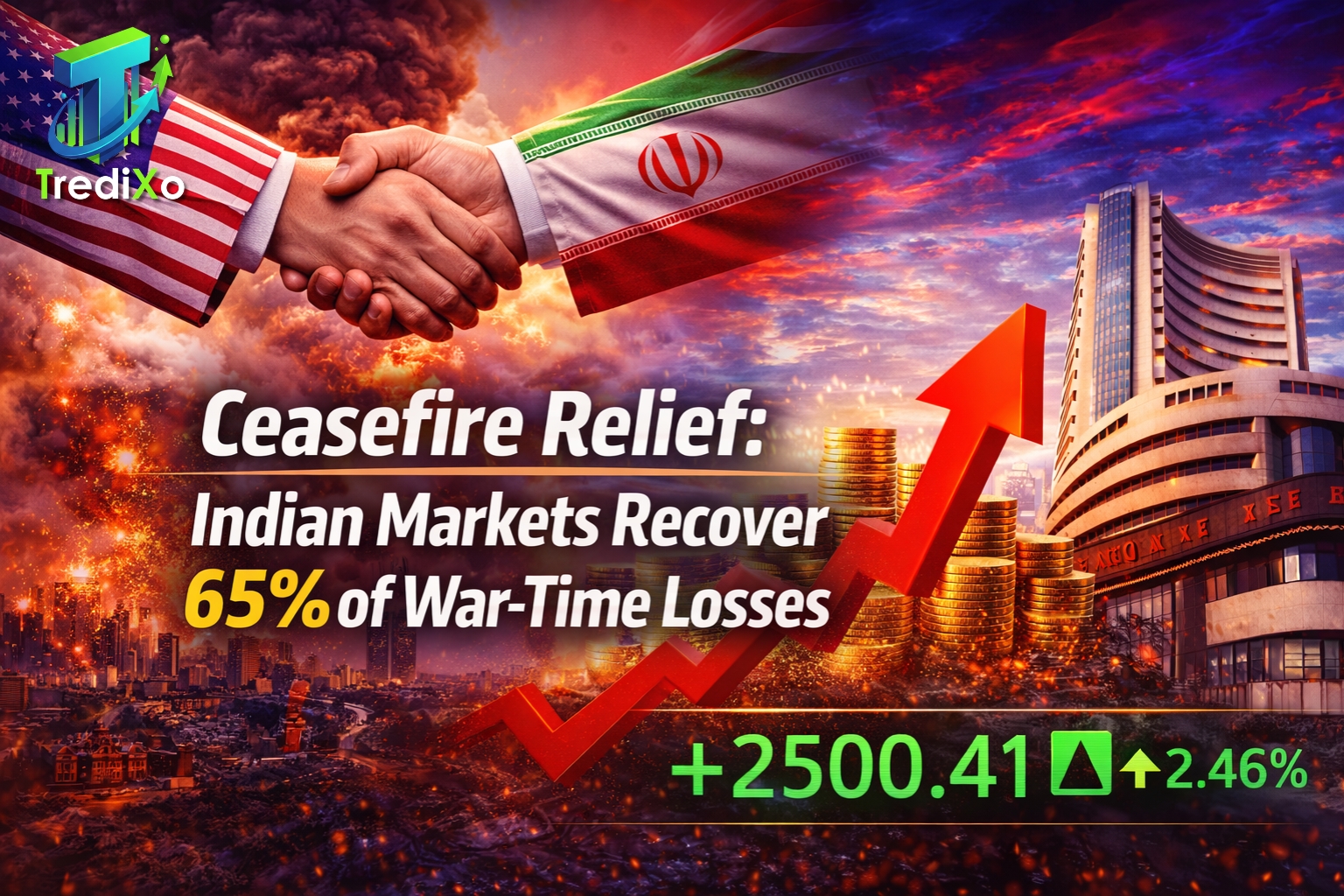
Ceasefire Relief: Indian Markets Recover 65% of War-Time Losses
Indian equity markets delivered a strong recovery as easing geopolitical tensions following the US-Iran ceasefire helped restore investor confidence. After days of sharp volatility triggered by rising oil prices and global uncertainty, benchmark indices bounced back sharply—recovering nearly 65% of the losses incurred during the peak of the conflict.
The rebound reflects how quickly sentiment can shift in financial markets when major global risks begin to fade.
From Panic to Relief
Just days ago, markets were under heavy pressure as tensions in the Middle East escalated. The possibility of supply disruptions, especially in key oil routes, pushed crude prices higher and triggered a risk-off mood globally. Investors rushed to safer assets, while equities—especially in emerging markets like India—faced strong selling.
However, the announcement of a ceasefire changed the narrative almost instantly.
With fears of escalation easing, global markets stabilized, and Indian equities followed suit. The Sensex and Nifty witnessed strong buying interest, erasing a large portion of recent losses and signaling renewed optimism among investors.
Oil Prices Play a Key Role
One of the biggest drivers behind the recovery has been the cooling of crude oil prices. During the conflict, oil had surged sharply due to fears of supply disruptions. For India, which imports a majority of its crude oil, higher prices translate into increased inflation and a wider current account deficit.
The recent pullback in oil prices has eased these concerns.
Lower crude prices reduce cost pressures for businesses, improve government finances, and support the rupee. This combination creates a favorable environment for equities, which explains the sharp bounce seen in the market.
Broad-Based Market Recovery
The recovery has not been limited to a few sectors—it has been fairly broad-based.
Banking stocks led the rebound, as improved sentiment around economic stability boosted confidence in the financial sector. IT stocks also saw buying interest, supported by a relatively stable global outlook and currency movements.
Auto and FMCG sectors benefited from expectations of lower input and fuel costs, while aviation stocks gained on hopes of reduced operational expenses. Even midcap and smallcap stocks, which had seen sharp corrections earlier, participated in the rally.
FII Activity and Global Support
Foreign institutional investors (FIIs), who had been cautious during the conflict, showed signs of returning as global risks eased. A stable global environment, along with improving risk appetite, supported inflows into Indian equities.
Additionally, global markets also reflected a similar trend, with major indices stabilizing as geopolitical tensions cooled. This synchronized recovery further strengthened sentiment in domestic markets.
Is the Worst Over?
While the recovery is encouraging, experts caution against assuming that volatility is completely behind us. Geopolitical situations can evolve quickly, and any renewed tension could again impact oil prices and market sentiment.
Moreover, investors will now closely track key economic indicators such as inflation data, central bank policies, and upcoming corporate earnings. These factors will determine whether the current recovery can sustain or face resistance.
Expert Perspective
Market analysts believe that the recent correction was largely driven by external factors rather than domestic weakness. “The fundamentals of the Indian economy remain strong. The recent fall was sentiment-driven, and with risks easing, markets are naturally rebounding,” said a market expert.
However, they also advise caution in the near term, as markets may remain sensitive to global developments.
What Should Investors Do?
For investors, the recent recovery is a reminder of the importance of staying calm during volatility. Panic selling during corrections often leads to missed opportunities when markets rebound.
A disciplined approach—focusing on strong fundamentals and long-term growth prospects—remains the best strategy. Diversification across sectors can also help manage risks during uncertain times.
Content Credit Goes To : Tredixo