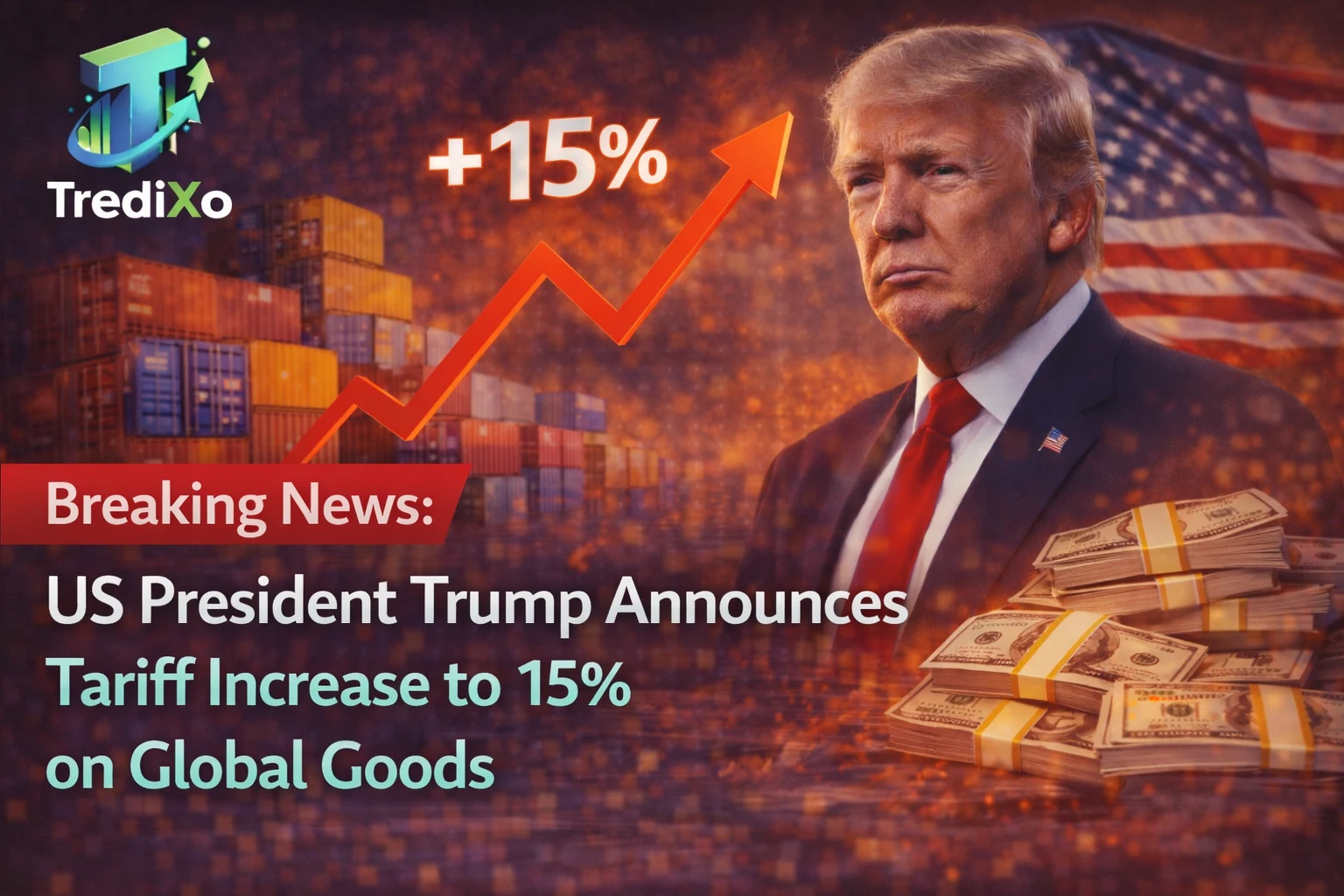
Breaking News: US President Trump Announces Tariff Increase to 15% on Global Goods

In a major escalation of global trade tensions, Donald Trump has announced a tariff increase to 15% on a wide range of global goods, marking a significant shift in United States trade policy. The move is aimed at protecting domestic industries but has raised concerns about higher inflation, disrupted supply chains, and renewed trade war risks.
The announcement comes at a time when global markets are already grappling with geopolitical uncertainty, slowing growth, and volatile commodity prices. Trump stated that the tariff hike is intended to “level the playing field” for American manufacturers and workers, emphasizing a tougher stance on imports.
What the 15% Tariff Increase Means
The newly announced tariffs will apply broadly to imported goods from multiple trading partners, rather than targeting a single country. This signals a more aggressive, protectionist approach compared to previous, more selective measures.
Key implications include:
- Higher import costs for businesses relying on foreign goods
- Potential pass-through of costs to consumers, increasing inflationary pressure
- Increased strain on global supply chains
- Rising uncertainty for exporters dependent on the US market
Economists warn that while tariffs may offer short-term protection to domestic industries, they can also reduce competitiveness and slow overall US economic growth.
Global Market Reaction
Financial markets reacted swiftly to the news. Equity futures showed signs of volatility as investors assessed the potential impact on corporate earnings and global trade flows. Traditionally, tariff announcements tend to pressure risk assets while boosting demand for safe-haven instruments.
Possible market effects include:
- Stock market volatility, especially in trade-sensitive sectors
- Currency fluctuations, with safe-haven currencies gaining appeal
- Commodity price swings, particularly in metals and energy
- Heightened inflation expectations, influencing central bank policy outlooks
Emerging markets, which rely heavily on exports to the United States, could face increased economic pressure if trade volumes decline.
Impact on Global Trade Relations
The tariff increase is expected to strain relations between the United States and its major trading partners. Several countries are reportedly reviewing countermeasures, raising fears of retaliatory tariffs that could further disrupt international trade.
Trade experts caution that a prolonged tariff battle may:
- Slow global economic growth
- Reduce cross-border investment
- Increase costs for multinational corporations
- Undermine long-term trade agreements
The move could also complicate ongoing negotiations on trade reforms and bilateral agreements.
Political and Economic Context
Trump’s decision aligns with his long-standing “America First” trade philosophy, which prioritizes domestic production and reduced reliance on imports. The announcement is also seen as politically significant, resonating with voters concerned about manufacturing jobs and trade deficits.
However, critics argue that higher tariffs act as a tax on consumers and businesses, potentially offsetting any gains for domestic producers.
Conclusion
The announcement of a 15% tariff increase on global goods marks a pivotal moment in US trade policy. While the move is designed to protect domestic industries, it carries substantial risks for global trade stability, inflation, and market confidence.
As investors, businesses, and governments digest the implications, markets are likely to remain volatile in the near term. The next phase will depend on how trading partners respond—and whether negotiations can prevent a broader escalation into a full-scale trade war. All credit goes to Tredixo .
FAQ
1. What did President Trump announce?
President Donald Trump announced a 15% increase in tariffs on global goods, expanding US import duties across multiple trading partners.
2. Why is the US raising tariffs to 15%?
The move aims to protect domestic industries, reduce trade imbalances, and encourage local manufacturing under the “America First” trade policy.
3. Will consumers be affected by higher tariffs?
Yes. Higher import costs are often passed on to consumers, potentially leading to increased prices and inflation.
4. How could global markets react to the tariff hike?
Markets may experience increased volatility, with pressure on equities and rising demand for safe-haven assets amid trade uncertainty.
5. Could other countries retaliate?
Yes. Trading partners may introduce counter-tariffs, which could escalate trade tensions and further disrupt global commerce.